10 Common Questions Regarding DMIT Counseling

Dermatoglyphics Multiple Intelligence test is a truly scientific study of the fingerprint patterns. It will helps  to understanding a great individual’s potential & personality Type. Dermatoglyphics Multiple Intelligence Test (DMIT) is based on understanding from Neuroscience, Genetics, Dermatoglyphics, Psychology and Embryology. This Test Assessment method has been formulated by scientists and Medical experts. DMIT Test has accepted by Entire world and also from renowned universities. Medical experts and Approved clinical experience confirmed that finger prints provide accurate analysis of humans Multiple Intelligences and inborn potential. Traditionally only IQ test is used to be a measurement tool for degree of intelligence. Now Dermatoglyphics Multiple Intelligence Test Using in the field of School College and educational institutions. Human resource management. Children memory Enhancements Programs. Career Guidance and Career Counseling.
    History of Dermatoglyphics

The research of Dermatoglyphics is usually more than 200 yrs. old. Dermatoglyphics was mainly used to find skilled sportsmen for Olympics Games in 1970s. Dermatoglyphics is invented by Dr.Harold Cummins. Dr.Harold Cummins is certainly acknowledged as Father of Dermatoglyphics. He studied almost all aspects of fingerprints analysis throughout fields. Dermatoglyphics was used Find Genetic disease with the help of fingerprint patterns. Dermatoglyphics Originated from Down Syndromes Theory.

  • What is DMIT :-

Dermatoglyphics & multiple intelligence Test. Dermatoglyphics is a scientific analysis of fingerprint patterns. The term Dermatoglyphics originates from two Greek words.

DERMA = SKIN

GLYPHE = CURVE

Fingerprints and dermal ridge pattern are unique with each individual. Even Fingerprints are differences between similar twins also. Discover your intrinsic potential by identifying the form and various types of styles on the finger.

  • What can I know from the Fingerprint Analysis test about myself?

 This test could be for an adult or a child and it tells you about:

·       You’re learning styles(Visual, Auditory, Kinaesthetic)

·       Your brain dominance (Left or Right)

·       Your Personality traits and behaviour patterns

·       Your relationship compatibility with other personalities

·       Why children are opposed to your thoughts and ideas

·       Why children are over active or stubborn

·       What are my potential subjects for higher studies?

·       What type of career will have scope to fulfil my potential?

  • Can Dermatoglyphics test help me?

Sometimes parents do not understand their child’s true potential. The tests help parents understand their child’s clear mind and brain cells, the distribution and function of strength, grasps child’s unique qualities and potential. Besides, they can also learn how children should be given proper learning environment so that we can follow according to the child’s personality characteristics and the mode of communication for him/her to achieve the function of raising a child mind in order to enhance the learning outcomes.

  • How accurate is the dermatoglyphics multiple intelligences test?

Dermatoglyphics is a professional industry that combines neurobiology, genetics and embryology. Fingerprint patterns are not random but are arranged according to individual genetic makeup.

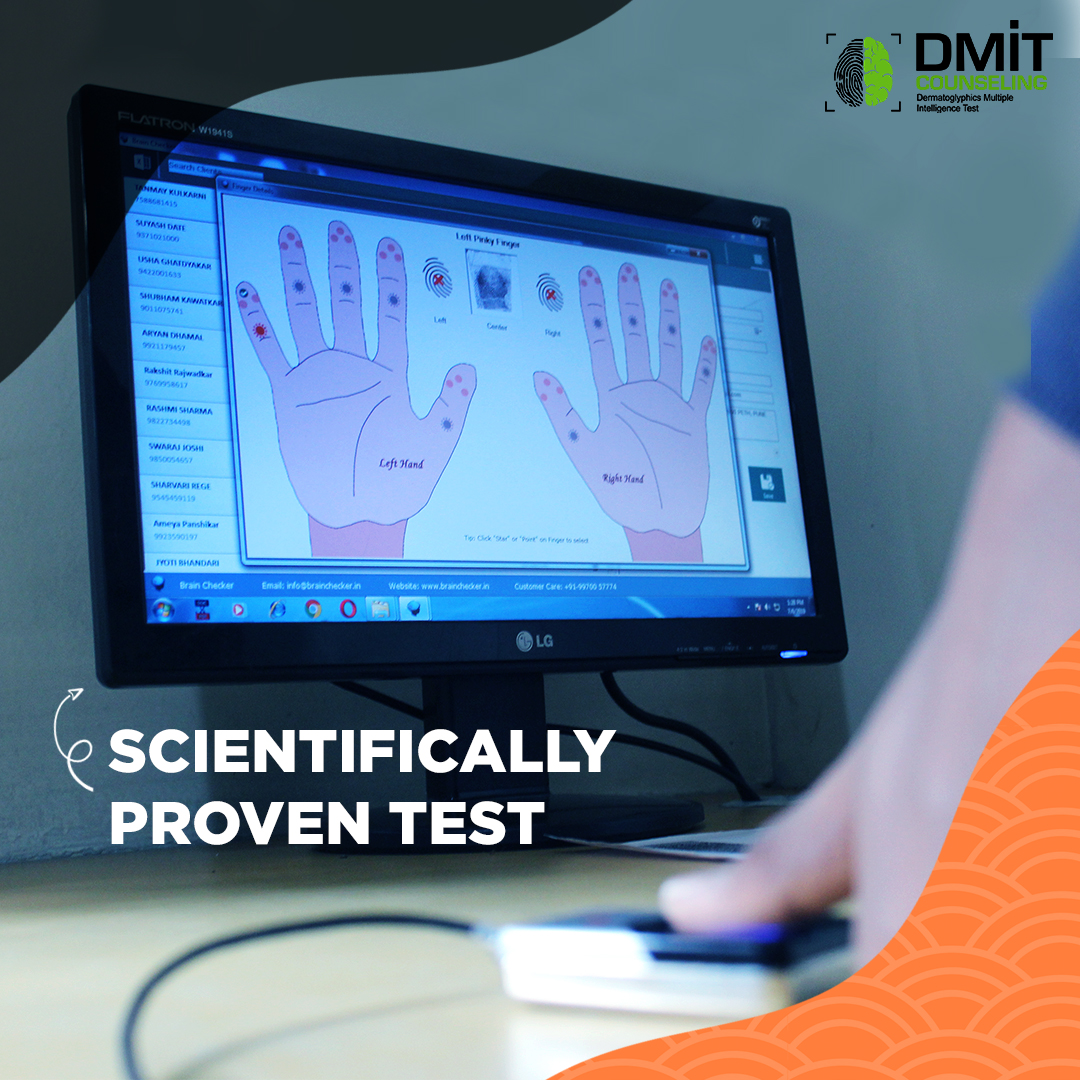
Dermatoglyphics multiple intelligences test is scientifically proven. Besides, the data acquisition process is computerized. Therefore, we can achieve an accuracy of more than 90%. Striae formation and formation of brain are synchronized with the foetus in the mother’s body in first 13 weeks to 19 weeks. It has been medically and clinically proven that striae and the existence of multiple intelligences are completely linked.

The proponent of multiple intelligences theory by Professor Howard Gardner states that multiple intelligences exist in the brain system and further identify the brain structures which are in-charge of the intelligence area. Therefore, sooner the child understands the situation of dermatoglyphics, better we can inspire and help the child’s multiple intelligence development as soon as possible.

  • Is Dermatoglyphics testing scientific or medical basic?

Both. Dermatoglyphics is based on many sciences, viz. medical sciences of genetics, embryology, dermatoglyphics, and brain science etc, use of observation, recording, and contrast, inductive learning methods coupled with clinical experience. It was concluded that from the striae we can accurately analyze the child’s multiple intelligences and potential personality.

  • Is Dermatoglyphics test an IQ test?

Dermatoglyphics test is not an IQ test but an intelligent narrowing definition of striae test of multiple intelligences, including linguistic intelligence, logical and mathematical intelligence, spatial intelligence, body – kinaesthetic intelligence, musical intelligence, interpersonal intelligence, introspective intelligence, and last but not least naturalist intelligence, which is included in the eight intelligence, where “IQ” can be simply summarized as a simple test which takes into consideration only logical and mathematical intelligence test.

  • How do we know your DMIT Report accuracy?

 DMIT Report Accuracy is depends on Fingerprint Analyst and DMIT Software Technology.

  • Which is the best centre to do DMIT Counseling in Pune

Dmit Counseling Pune.

  1. Who are the counseler in DMIT Counseling Pune?

Kedar Takalkar and Vedashree Gokhale  – is a dynamic team of professionals from various fields who have come together to spread Dermatoglyphics Multiple Intelligence Test concept in PUNE, Headed by Mrs. Vedashree Gokhale  & Team of Kedar Takalkar classes is committed for the awareness of D.M.I.T. and great education all over in Pune

This all information is provided by DMIT Counseling Pune.

5 Time Management Tips For Students

Today I want to discuss the crucial subject of Time management. I call it crucial because I know that most of the students genuinely do not get free time. I moreover think that student’s life is worse than that of the parents working in MNCs. Students are busier than them. Hence Time management is very important.

Study Management Tips by DMIT Counseling

1) If your child is a toddler and yet to take admission in the school,  I will always recommend to choose a school nearer to your home as I have observed that most of the time is wasted in travelling.2) Students and parents should analyse the time wasted by the children in gossiping, chatting, mobile phones and excessive use of T.V This is a real waste of time called as passive entertainment. However, reading books, attending a hobby class, watching a T.V for entertainment for half an hour is considered as an active entertainment.3) Time wasted in passive entertainment needs to be rectified and must be used appropriately.However, time invested in active entertainment will gear up the students for the study.4) Also students invest lot of time to do self study. Completion of books/Copy writing can never be counted in self study. Hence, I suggest that students should manage their time for both but prioritise self study as it will lead to strengthen the foundation of knowledge and improve the performance.5) Never keep your self study time immediate after the school or class. Your brain will not be ready immediately to absorb the knowledge. So you need to rest before you start fresh. The rest can be a hobby class, entertainment, playing etc.

How to manage the time?

I would like to discuss the case study of my student here. He was in 8th SSC last year. I had given him the similar technique of study that I mentioned in my first post. (15th August 2019.)He used to go to the school from 7 am to 1.40 pm. He returned home by 2pm. I told him to relax from 2 to 4 pm. (A short nap as he used to get up early, watching T.V and playing).4.30 to 6 pm he had his tuition. I again gave him 1 hour for relaxation. At 7 pm he used to start his self study and would do it by 9pm. Then he had his dinner with his parents. After that 10 to 11pm he used to complete his books. (Purposefully the book completion which involves writing is kept at night where brain just needs to do copy writing.)This is just an example. The schedule was made considering the comfort zone of the student. However, if the child’s comfort is taken into consideration, you can definitely plan a schedule where the child will surely get the time for self study. Also, the child will happily follow it as all his activities is also considered in this schedule. Banning the hobbies, putting extra restrictions on the child can never fetch the success. On contrary, it will make the child negative towards the study. Such schedules make the process easier for the child to adapt. Gradually this becomes their habit and becomes easier in the higher standards. Hope this works out for all Parents. Please let me know about the feedback. Happy learning!!!For more details or Career Guidance book your appointment with DMIT Counseling.

DMIT vs.Conventional Career Counseling

About DMIT:
Dermatoglyphics refers to the branch of science which constitutes the study of the patterns i.e. prints of skin (dermal ridges) on the fingers, toes and the soles of human beings. Dermatoglyphics Multiple Intelligence test is a biometric assessment of the individual’s finger prints to map his/her brain functioning.
Conventional Career Counselling, on the other hand takes aid of standardised Psychometric Tests in order to identify an individual’s intelligence, interests, aptitude and personality. These factors are then carefully analysed and a summary of most suitable careers is drawn for the individual, keeping in mind his/her identified attributes.
To briefly discuss the history of DMIT: in 1926, Harold Cummins proposed the term “Dermatoglyphics” for the study of fingerprints at the American Morphological Society. After this, Noel Jaquin researched and proposed that each fingerprint pattern corresponds to a specific type of personality, in the year 1958. Subsequently, in the year 1981, Professor Roger W. Sperry and his co-researchers were awarded the Nobel Prize in Biomedicine for their research work on the left and right brain functions as well as the dual-brain theory. Finally, in 2008 Prof. Lin Ruei procured U.S. Patent for Dermatoglyphics.
DermatoglyphicMultiple Intelligence Test [DMIT] came into being when the idea of Dermatoglyphics was combined with the theory of Multiple Intelligence. Multiple Intelligences was theorised by developmental psychologist Howard Gardner in the year 1983 in his book ‘Frames of Mind: The Theory of Multiple Intelligences’.
Gardner’s theory opposes the idea of one dominant factor of intelligence. He states that there can be several different types of intelligences, i.e. linguistic, musical, kinaesthetic etc. The idea is to not generalise intelligence as one factor and put a numerical value to it, but to identify the areas towards which the individual has inclination in terms of potential and interest. For example, a child with low IQ score as determined by convention methods could have an exceptional musical ability, a feature often observed in William’s syndrome, that would be his specific intelligence.
Career Counselling process, as mentioned earlier, tests an individual on three different parameters. Intelligence: which informs about the overall cognitive capacity of an individual to understand instructions and adapt to the environment. Aptitude: this helps identify the specific area in which an individual has potential. Interest: this is an objective and systematic method of concluding which field will be most suitable for the individual, given the activities that interest him. Personality: different jobs require a different personality type. For example, it would be very difficult for a shy and introvert person to be a party conductor. Thus knowing one’s personality traits and determining the career path ensures that one enjoys their work in a stress free manner.DMIT is, hence, a so called ‘psychometric’ tool to assess the specific intelligence and innate aptitude of an individual. Proponents of DMIT advocate it to be a better alternative to Conventional Career Counselling.
By the time a foetus is six months old and approximately 12 inches in size, his/her fingerprints and footprints are fully developed. Once formed fingerprints are static and do not change with age—so an individual will have the same fingerprints throughout life. This is pointed out as an advantage of the DMIT technique, as the results are a pure measure of innate abilities, not tampered by environmental conditions. However, Environmental factors definitely play a role in finger print formation, such as the foetus’s exact location in the womb as well as the density of the mother’s amniotic fluid. Conventional Career Counselling, on the contrary, does not claim to measure innate factors exclusively, rather it takes into account both genetic and environmental factors.One of the main pros of DMIT that is often emphasised is that the test cannot be forged or get confounded by social desirability as it is not possible for the client to influence the input. This is the primary advantage that DMIT claims to have over Conventional Career Counselling. However, most of the psychometric tests used in the process of Conventional Career Counselling have an in-built lie scale or some sort of correction for social desirability. Therefore, this argument is not entirely one-sided.
Criticism of DMIT:
To begin with, DMIT is adherent to the premise that intelligence, interests and behaviour patterns are innate i.e. physiological/genetic and have no influence from environmental factors, whatsoever. In the nature v nurture conflict it lies entirely on nature end of the continuum. This could potentially be the biggest drawback of the concept, since cumulative research has notably suggested that it is a confluence of the two. Genes make a substantial difference in intelligence, but they are not the sole determining factor. They account for about half of all differences in intelligence among people; the other half comes from environmental factors.
Genetic determination of intelligence also implies that one’s aptitude, interest and behaviour patterns are fixed and have no scope of change through lifetime; this again could not be further from the observed truth. An individual could be weak in, let’s say numerical ability, in their school years but develop impressive numerical ability in adulthood. One’s aptitude increases and enhances with experience and practice.
The psychometric measures used in the process of conventional career counselling identify the individual’s aptitude at that given point of time. Thus the results that are obtained reflect a constellation of all the factors that have played a role in the individual’s life and hence the individual’s present potential. The traits that are measured via this process are a confluence of both, one’s innate abilities and one’s learning. Thus the results might not be identical at all points of time, which is a good thing. Since Convention Career Counselling can capture the enhancements that an individual has gone through and accordingly suggest what’s best for him/her from here onwards.Secondly, DMIT attempts to measure factors likeIQ, AQ, and EQ etc. IQ means “Intelligence Quotient” which is a numerical representation of one’s intelligence. Scientific research has, till date, shown no specific correlation between IQ and fingerprints. Same applies for the other ‘Quotients’ as well. Conventional Career Counselling on the other hand, uses thoroughly researched, standardised tests that have been validated and proven reliable, where each item is carefully selected, to measure one’s IQ.
Thirdly, DMIT is entirely based on the concept of Multiple Intelligences by Dr. Howard Gardner, with many arguments suggest that Gardner’s theory is not built on empirical evidence and is actually recognized as an example of pseudoscience. It is more of a concept rather than an empirically proven framework or model of intelligence.
Fourth, another concept that DMIT heavily relies on is that of the ‘left-brain vs. right brain lateralization’ which became popular after the findings of neuropsychologist Roger W. Sperry’s ‘split-brain experiments’ in1970’s. These findings are now outdated and recent researches point towards the contrary. There is a growing body of evidence suggesting ‘brain plasticity’ as opposed to brain localisation, meaning that the brain works like a whole network rather than different areas specialising in different functions. Thus this theory lacks support from modern brain research.
The origins or a start of the ‘finger-brain lobe connection’ can be traced to Taiwan, and in specific the works of education Professor Lin & kindergarten Principal Mary Lai. They proposed the ‘finger-brain lobe connection’ hypothesis – which suggests that each finger represents a brain lobe on the opposite side of the body. This too is contradictory to brain research findings, that conclude that all five fingers have the strongest connection with only a small parts of the brain that is known to represent the ‘primary motor cortex’ and the ‘primary sensory cortex’. For example, according to DMIT ‘Musical Intelligence’ manifests in the hand through the left ring finger and is assumed to correlate with especially the right temporal brain lobe. Actually, according the cognitive neuroscience research today, musical skills actually require the involvement of both hemispheres and various brain lobes from both hemispheres are involved in the processing of music.

Some serious concerns

Since DMIT claims to report a child’s aptitude and interests from toddler years onwards, and also suggests that education and parenting should be tailored accordingly, this can have devastating implications in events when the analysis is inaccurate. This will lead to the child being put in a box and forced towards only one kind of activities that he/she might not be suited for.Such a pattern of upbringing is detrimental to exploration and to the freedom of choice, at the core. It is a natural part of development to try out new activities and consequently infer what one’s best fit is. Since DMIT claims to pre analyse what one’s best fit is, this process is thwarted, and so is a major area of personality development.
The errors in Conventional Career Counselling are less likely, since they are self-report tests, and also heavily based on scientific research. Also it suggests the best career path for an individual while giving a summary of their interests, aptitude and personality. It does not concretise an individual to a particular field. Additionally, it recognises that one’s interests,  personality and aptitude change throughout life, and thus conventional career counselling is a lifelong process and takes into account these changes.
Conclusion:
To conclude, while DMITCounseling comes with a new and innovative method of career Counseling, it might not be the most trustworthy. Conventional Careercounselling might come with its own set of drawbacks, but it is a well-tested and scientific method. This model has been functioning well for years, and if it must get replaced, it should be with something that stands even more firmly on scientific grounds. Since, what career path to choose is one of the most important decisions in an individual’s life, it can, therefore, certainly not be taken a chance with.

How Reading Help Childs Educational School Life.

Now a days every child has the strength and power to succeed in educational life and every parent, can help. Main question is: How can we help our children to succeed? The answer is a combination of common sense and research about how children learn and how to prepare them to learn. Just example, that children tend to do the same things as their parents do. Whatever we tell and do in our daily lives it can help them to develop positive attitudes toward school learning and helps to build confidence in themselves as learners. Showing our children that we both gives important to education and use properly it in our daily lives provides them with powerful models and contributes greatly to their success in school. When parents and families are involved in their children’s education life, the children do better and have feelings about going to school. We help our children to succeed by co-ordinate with teachers to make sure that they provide curricula and use teaching methods that are based on best strong scientific evidence about what works best in helping students to learn. The purpose of writing this blog is to make available to you information that you can use to help your child to succeed in educational life.

Activities

You may follows our activities that you can do with your child to help build the skills, attitudes and behaviours needed for school education success. The activities age level are indicated at the start of each activity: Ages 5-7,  Ages 7-9 Ages 9-11 keep in mind, however, that children don’t always learn the same things at the same rate. Parents are the best judge of what your child may be ready to try, so you can use the age levels as guides as your child learns and grows, not as hard and fast rules. Many times an activity listed for children ages 7–9 may use to 5-year-old child. On the other hand, the same activity may not applicable to child until he is 9 or 10. Every parents has a dream that their, child want to learn in a way no one else can. That desire or thirst to learn is a key to your child’s later success. Enjoyment is important! So, if you and your child don’t enjoy any activity, then it’s time to move on to other activity. You can always return or choose to any activity after some period on.

Encourage Your Child to Read

Help your child to become a reader. This is the single most important thing that you can do to help the child to succeed in school life as well as in life. The importance of reading simply can’t be overstated. Reading is very important to children in all to learn all school subjects. Here we are providing some tips on how to help your child become a reader.

Start early. When any child is still a baby, reading aloud to him. This is very important method and parents should become part of their daily routine. At beginning, read for no more than a 4- 5 minutes at a time, but 2-3 times a day. As your child grows younger or older, you should be able to tell if he means your child is wants you to read for longer periods. As you read, talk with your son or daughter always encourage him to ask questions and to talk about the story whatever he read. Ask him to predict what will come next. When your child starts to read, please ask him to read to you from books that he enjoys. Also make sure that your home has lots of reading materials that are appropriate for your child. Keep books, magazines and newspapers in the house. It is definitely not necessary that reading materials should have to be new or expensive. You definitely find best books and good magazines for your children at library. Also suggest your family members and friends to consider to give your child books and magazine as any kind of gifts for birthdays or other special occasions. Set aside quiet time for family reading. Some people may enjoy reading book or any blog aloud to each other, with each family member choosing a book, story, poem or article to read to the others. ß Show that you value reading. Let your child see you reading for pleasure as well as for performing your routine activities as an adult—reading letters and recipes, directions and instructions, newspapers, computer screens and so forth. Go with your child to the library and check out books for yourself and also for your child. When any child observes that reading is important to the life, then child will be likely to decide that it’s important to her, too.

Get help for your child if he has a reading problem and also help them to solving problem. The important thing is that no matter how time it takes, most children definitely can learn to read. Parents, teachers and other professionals can work together to determine if a child has a learning disability or other problem and then provide the right help as soon as possible.

This is all about reading strategy how to develop your child educational future. In Next blog we will see how to solve problem with talking and how it is important to decide career future.

All About DMIT

Introduction

First of all lets see what DMIT is, basically it is stand for Dermatoglyphics Multiple Intelligences Test. It is designed to develop a faithful and tested character and behavioural judgment suitable for use in human resource placement in industry, military, trade and commerce, education, personal adjustments, forensic sciences & career development. These judgments are based upon the individual biometric traits that one is born with. There is no age limit for this test. Anyone can discover his/her hidden talent at any age through      

Dermatoglyphics Multiple Intelligences Test (DMIT). DMIT discovers the inborn talent of a child through globally recognized science of DMIT. Report helps a person in choosing his stream ARTS/COMMERCE OR SCIENCE during his studies. It also helps in choosing one’s career say Doctor? Engineer? Artist? Cricketer? Teacher? Designer? Lawyer? Bank Manager? Chartered Accountant? Singer? Musician? Businessman? And so on…..

Multiple Intelligence

Scientifically it has been verified that the development of the brain, its lobes and fingerprints is done during the 7th and 21st week of pregnancy. Therefore there is a direct correlation between the development of the brain and fingerprint. During the development the information is transcribed as our finger prints that are unique for everyone. All with the Science of Dermatoglyphics one understands persons hidden potential and talents. This is a technology or a science which studies the patterns of skins (dermal) ridges present on the fingers, toes and the soles of human. It opens or reveals the congenital/hereditary or inborn links between our fingers and our intrinsic qualities and talents.

 DMIT

In this word DMIT Dermatoglyphics, came from ancient Greek words “derma” it means skin and “glyph” meaning is carving, this means the scientific study of the fingerprints. It is a perfect scientific proven method to decode or to calculate the brain’s potential and talent. Through the physical formation of fingerprints, which has linkage or connected to brain development. It isn’t means that this is Palmistry and is future telling it is straight forward technology.

In this term DMIT the Dermatoglyphics is a professional industry that combines or includes neurobiology, genetics, brain science and embryology coupled with clinical or medical studies. In elaborating or explaning this system, experts from Dermatoglyphics took psychological pattern profiles with more than 500 thousand individuals since 1985 across China, Japan, Korea, Taiwan, Singapore and Malaysia to generate a database for cross verification and comparison study which can help individuals to learn the way to discover their inner potential. Dermatoglyphics Multiple intelligences test is scientifically proven. Besides, data acquisition process is computerized. That’s why, we are able to achieve an accuracy of more than 90%. All human body prints formation & formation of brain are synchronized with the fetus in the mother’s body in first thirteen weeks and first nineteen weeks. It has been medically / scientifically & clinically proven that body prints and existence of multiple intelligences are completely linked. Various Functions of DMIT at different ages. DMIT provides various reports that deal with family, relationships, children’s education, the corporate world and marital life.

Toddlers (age 1-4): DMIT discovers the hidden inborn talent of Kids. DMIT is scientifically recognized knowing a toddler’s potentials at the early age will help parents make decisions on parenting charms and educational methods.

Children (age 4-12): In this age of four to twelve, Children are very curious to learn / know and they can absorb more than they will, when they grow older. To find or to know their learning styles and areas of intelligences in this age gives a clue on what courses and activities they should spend more time on.

Kedar Takalkar and Vedashree Gokhale – is a dynamic team of professionals from various educational field who have come together to spread D.M.I.T. concept in Pune.

Introduce Yourself (Example Post)

This is an example post, originally published as part of Blogging University. Enroll in one of our ten programs, and start your blog right.

You’re going to publish a post today. Don’t worry about how your blog looks. Don’t worry if you haven’t given it a name yet, or you’re feeling overwhelmed. Just click the “New Post” button, and tell us why you’re here.

Why do this?

  • Because it gives new readers context. What are you about? Why should they read your blog?
  • Because it will help you focus you own ideas about your blog and what you’d like to do with it.

The post can be short or long, a personal intro to your life or a bloggy mission statement, a manifesto for the future or a simple outline of your the types of things you hope to publish.

To help you get started, here are a few questions:

  • Why are you blogging publicly, rather than keeping a personal journal?
  • What topics do you think you’ll write about?
  • Who would you love to connect with via your blog?
  • If you blog successfully throughout the next year, what would you hope to have accomplished?

You’re not locked into any of this; one of the wonderful things about blogs is how they constantly evolve as we learn, grow, and interact with one another — but it’s good to know where and why you started, and articulating your goals may just give you a few other post ideas.

Can’t think how to get started? Just write the first thing that pops into your head. Anne Lamott, author of a book on writing we love, says that you need to give yourself permission to write a “crappy first draft”. Anne makes a great point — just start writing, and worry about editing it later.

When you’re ready to publish, give your post three to five tags that describe your blog’s focus — writing, photography, fiction, parenting, food, cars, movies, sports, whatever. These tags will help others who care about your topics find you in the Reader. Make sure one of the tags is “zerotohero,” so other new bloggers can find you, too.

Design a site like this with WordPress.com
Get started